
What is CDT
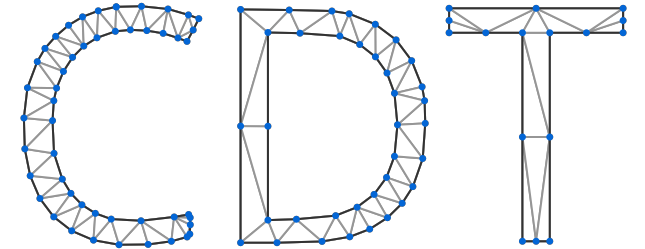
CDT is a C++ library for generating and refining constraint or conforming Delaunay triangulations.
- open-source: permissively-licensed under Mozilla Public License (MPL) 2.0
- cross-platform: tested on Windows, Linux (Ubuntu), and macOS; tested architectures:
x64andarm64 - portable: backwards-compatible with C++98
- bloat-free: no external dependencies by default
- flexible: can be consumed as a header-only or as a compiled library
- performant: continuously profiled, measured, and optimized
- numerically robust: triangulation algorithms rely on robust geometric predicates
If CDT helped you please consider adding a star on GitHub. This means a lot to the authors 🤩
Table of Contents
- What is CDT
- Table of Contents
- What can CDT do?
- Properly Handling the Corner-Cases
- Refinement
- Online Documentation
- Algorithm
- Implementation Details
- Adding CDT to your C++ project Using a Package Manager
- Installation/Building
- Where to find CDT API
- Code Examples
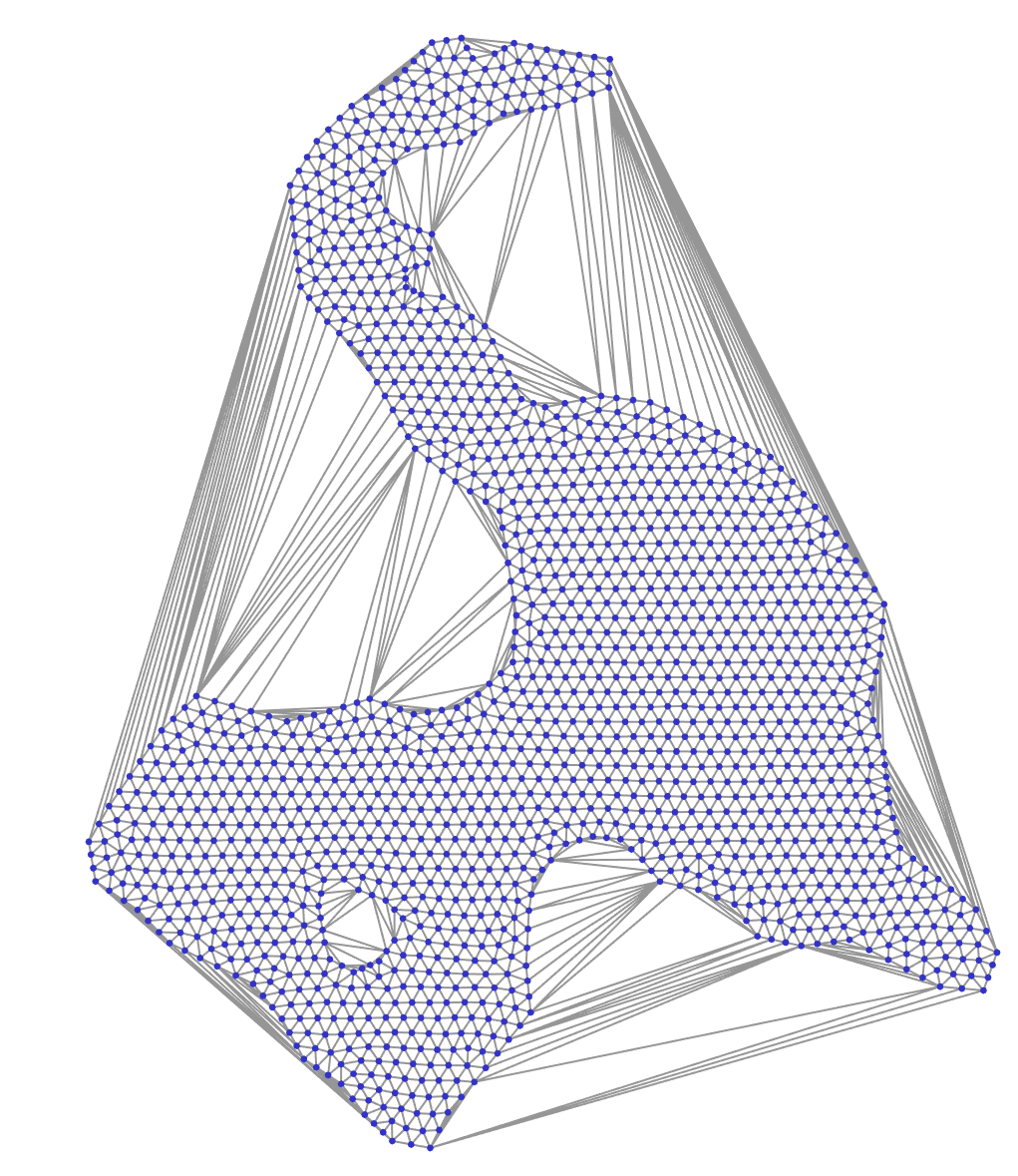
- Delaunay triangulation without constraints (triangulated convex-hull)
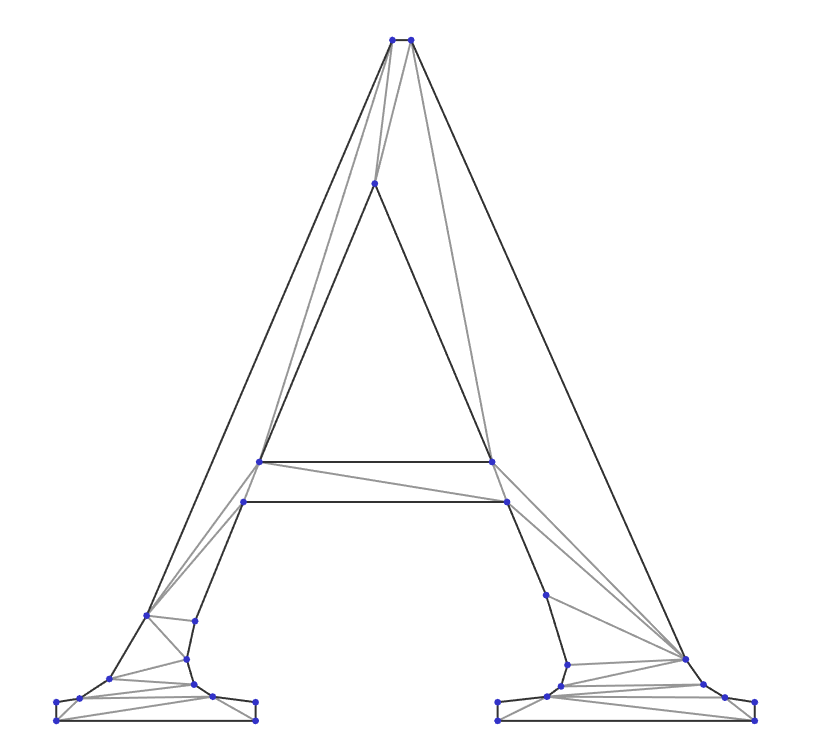
- Constrained Delaunay triangulation (auto-detected boundaries and holes)
- Conforming Delaunay triangulation
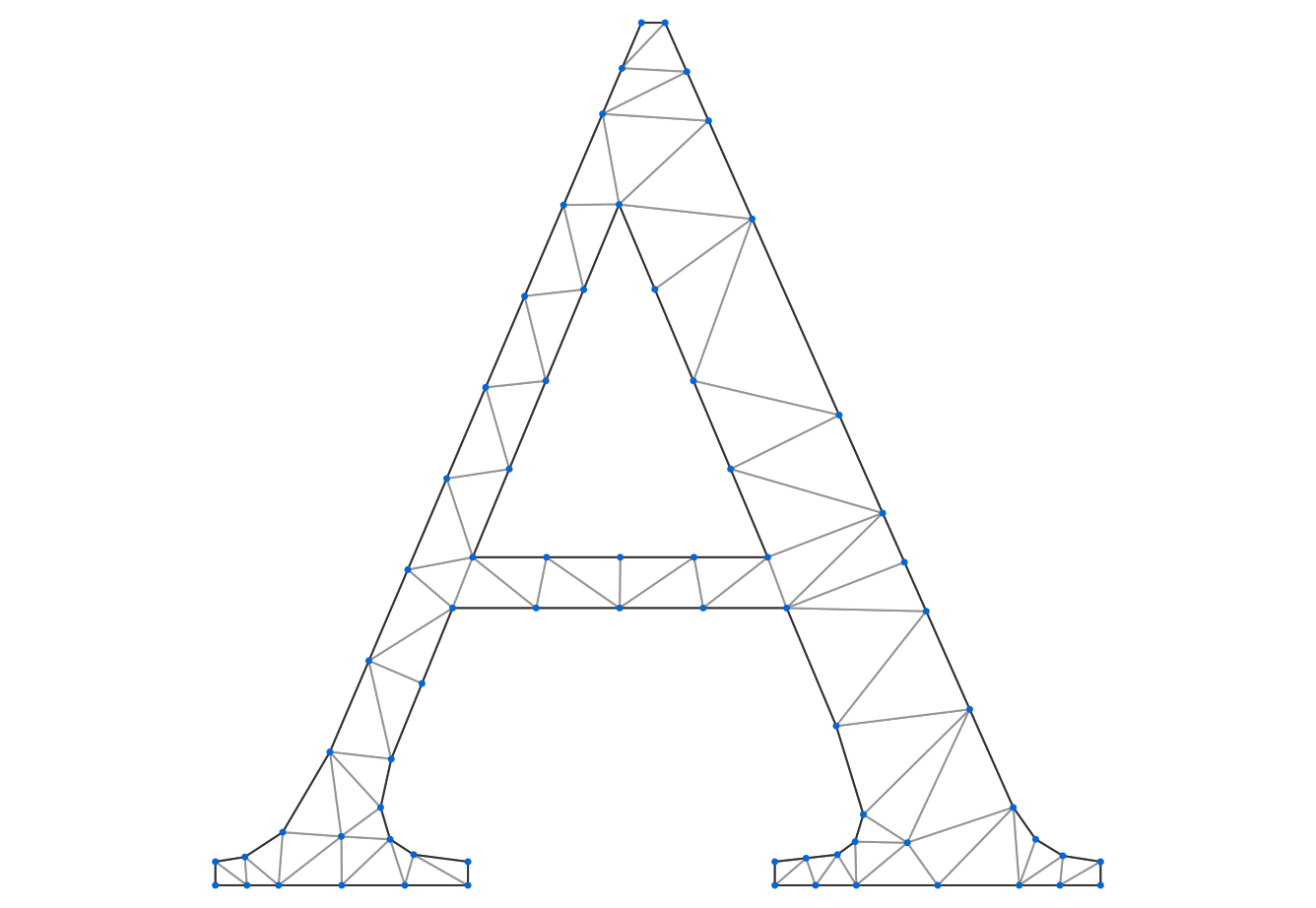
- Refinement
- Resolve edge intersections by adding new points and splitting edges
- Custom point/edge type
- Callbacks
- Error handling
- Python bindings?
- Contributors
- Contributing
- License
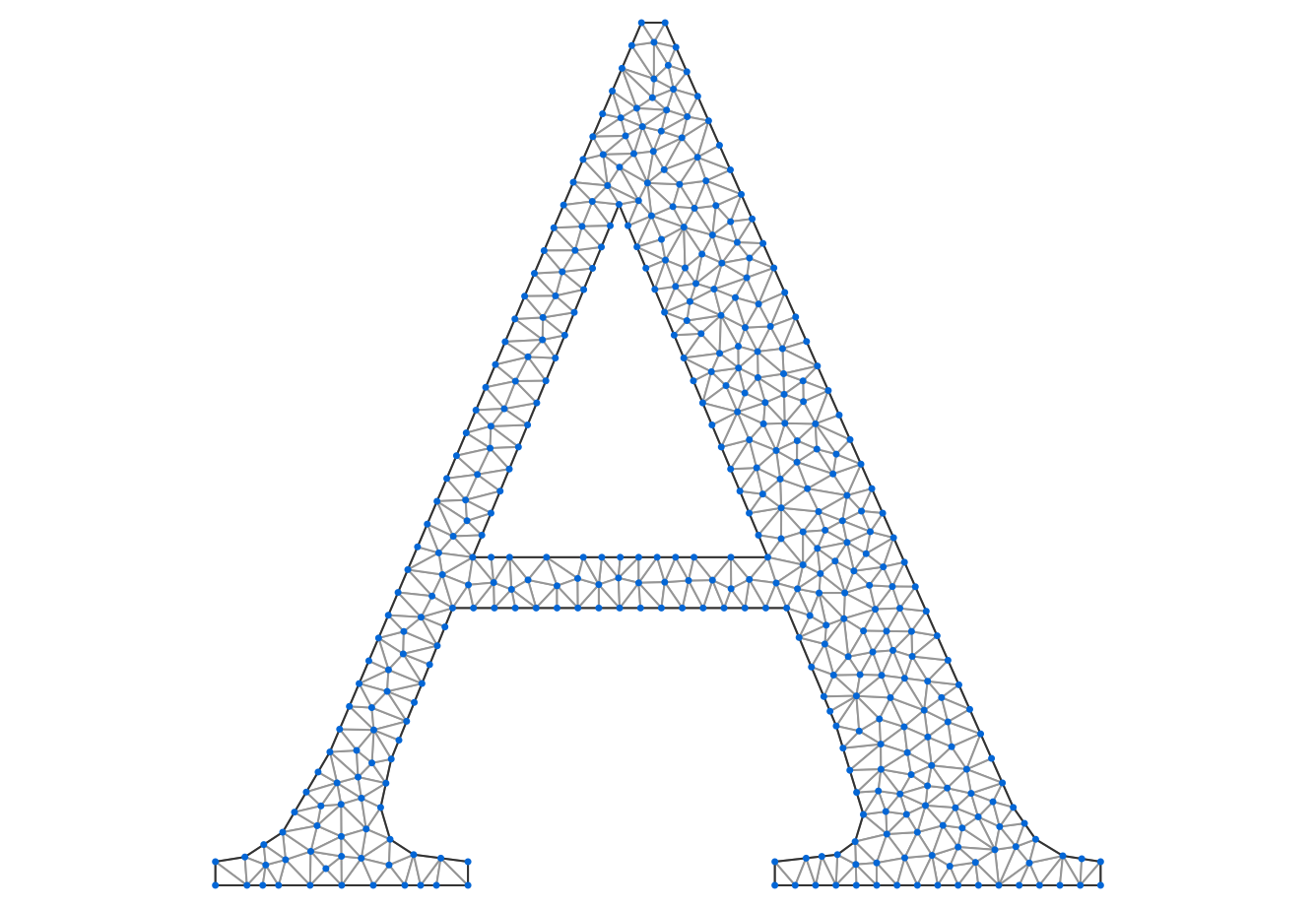
- Example Gallery
- Bibliography
What can CDT do?

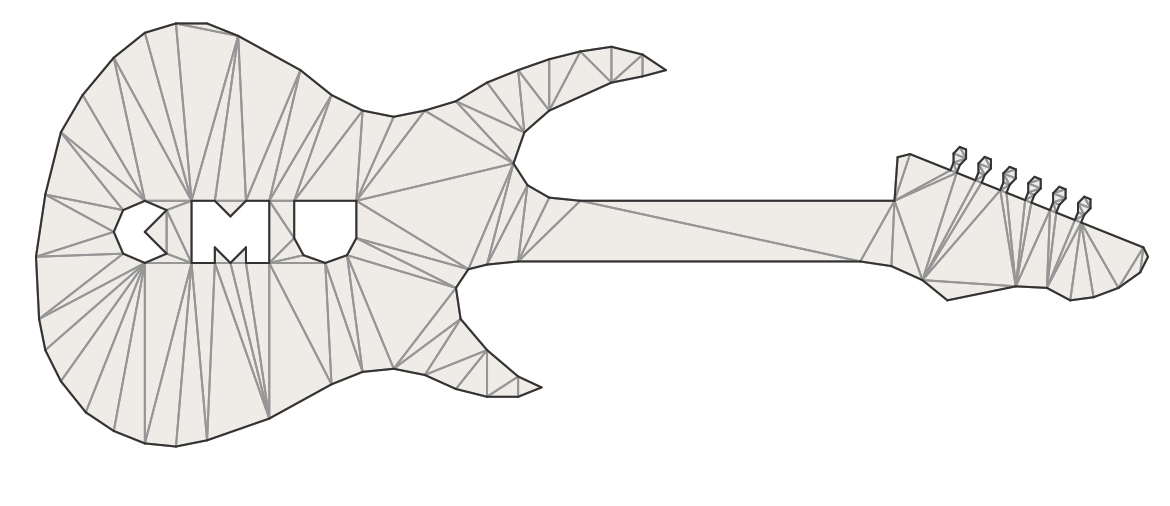
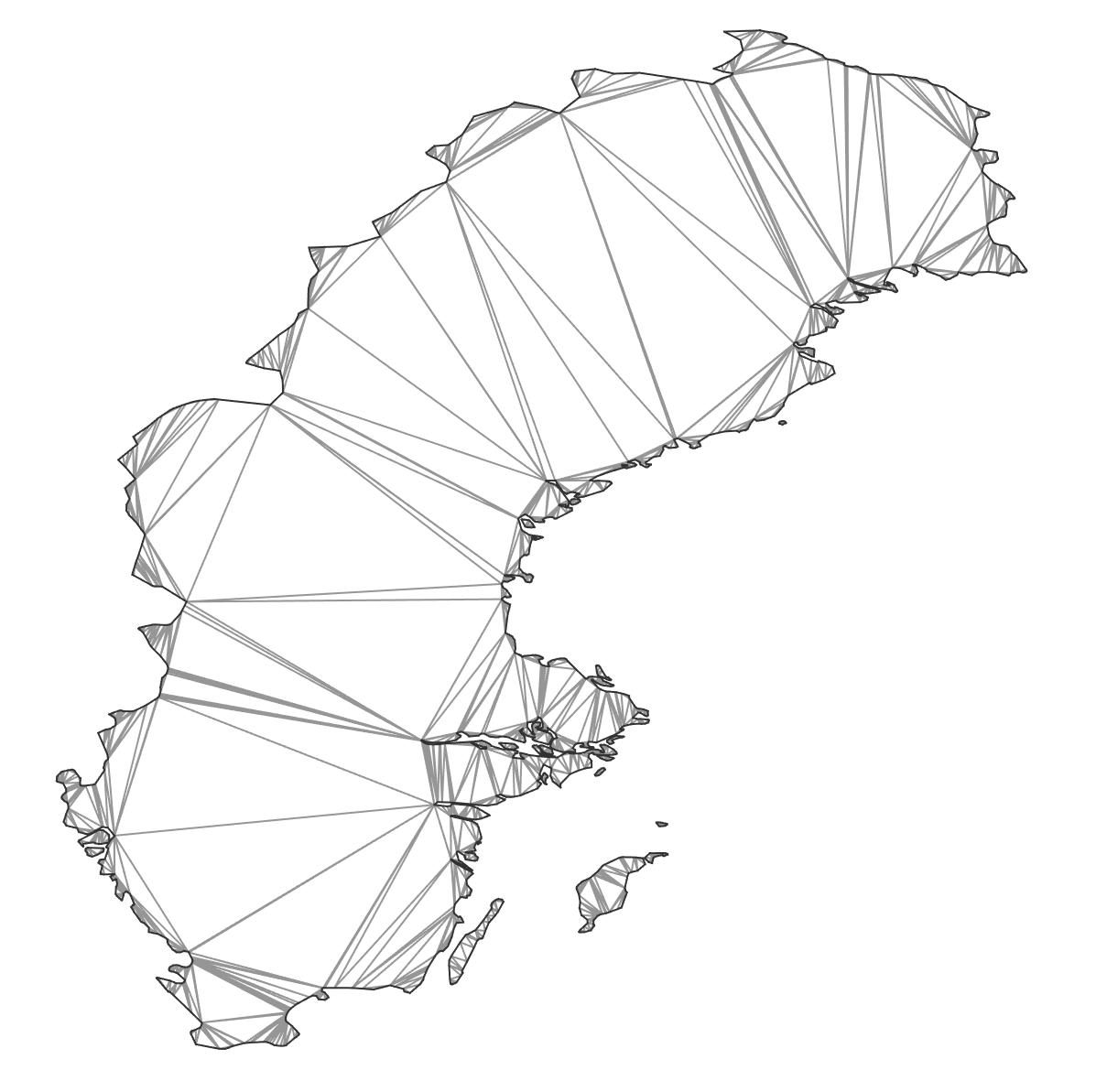
- Constrained Delaunay Triangulations: force edges into Delaunay triangulation
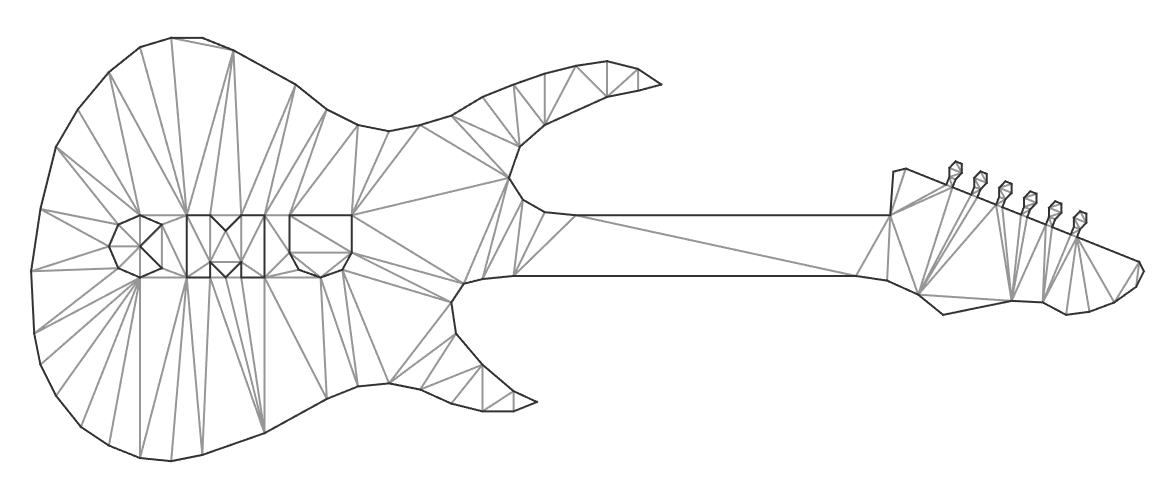
- Conforming Delaunay Triangulations: add new points into Delaunay triangulation until the edge is present in triangulation
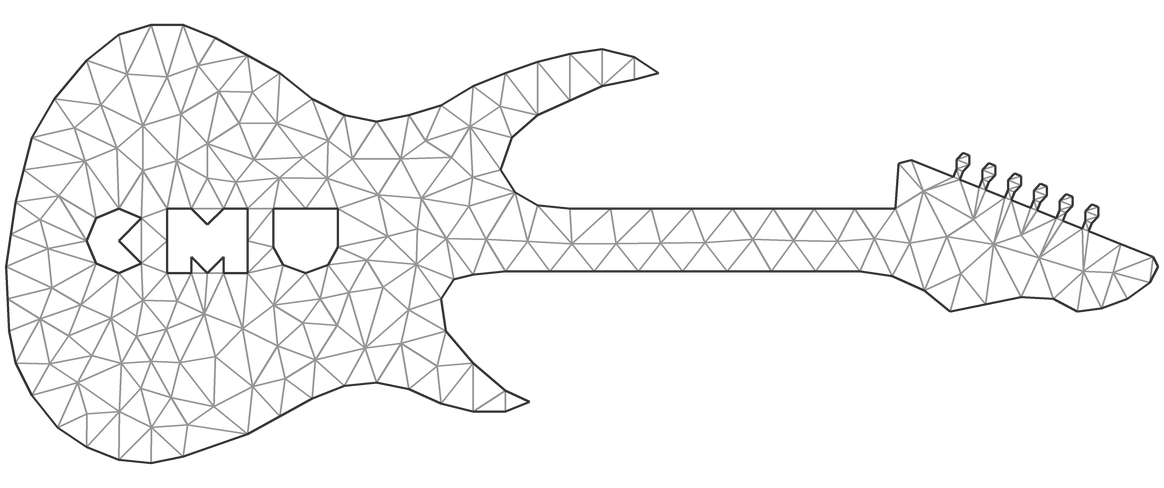
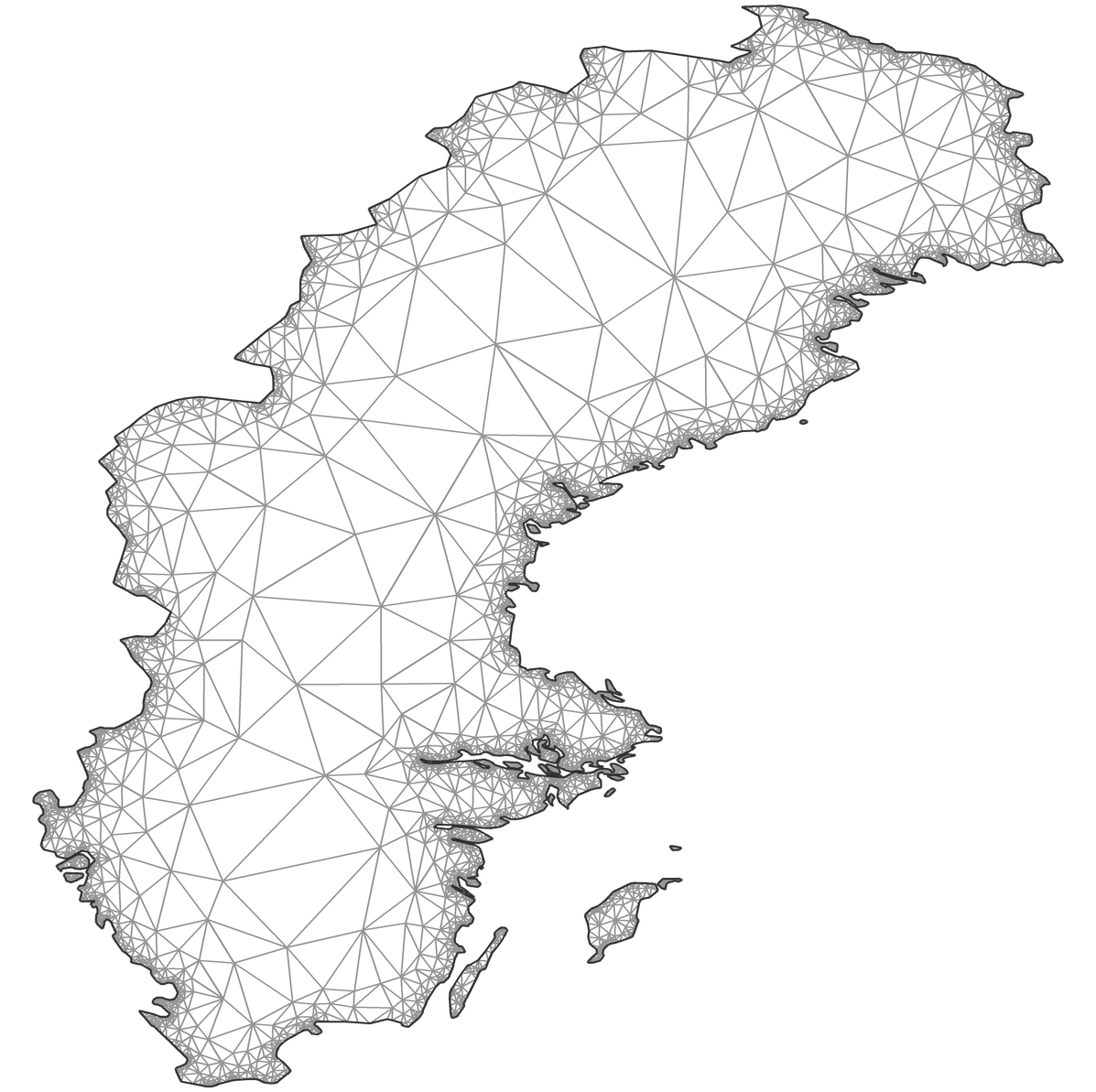
- Refinement: add new points until triangles fulfill a minimum-angle or maximum-area criterion
- Convex-hulls
- Automatically finding and removing holes
Properly Handling the Corner-Cases
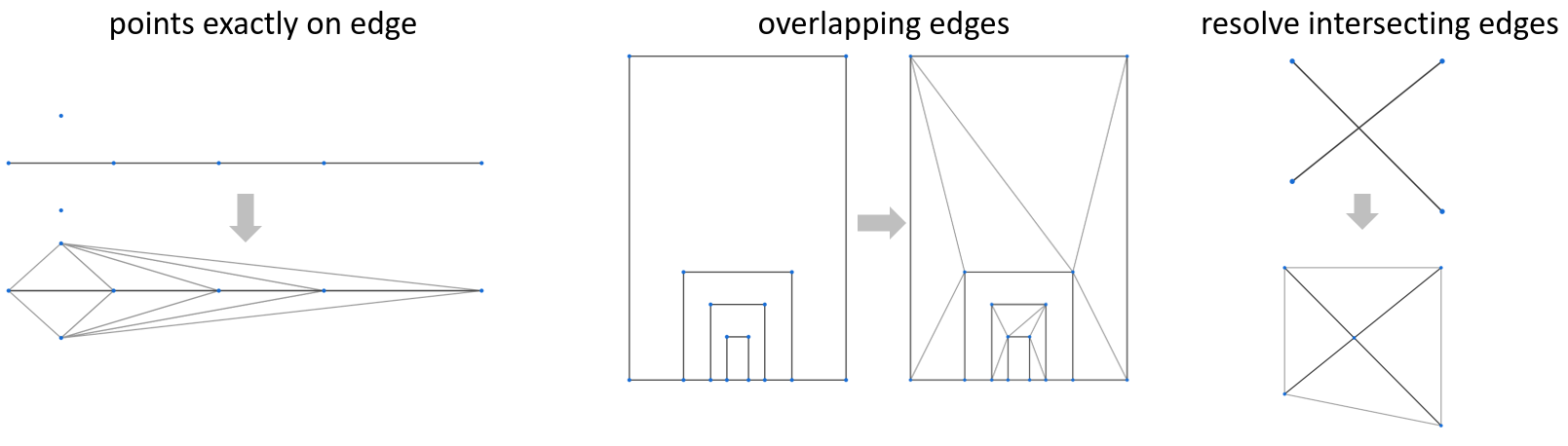
- Points exactly on the edges
- Exactly overlapping edges
- Resolving intersecting edges by adding points at the intersections (with
CDT::IntersectingConstraintEdges::TryResolve)
Refinement
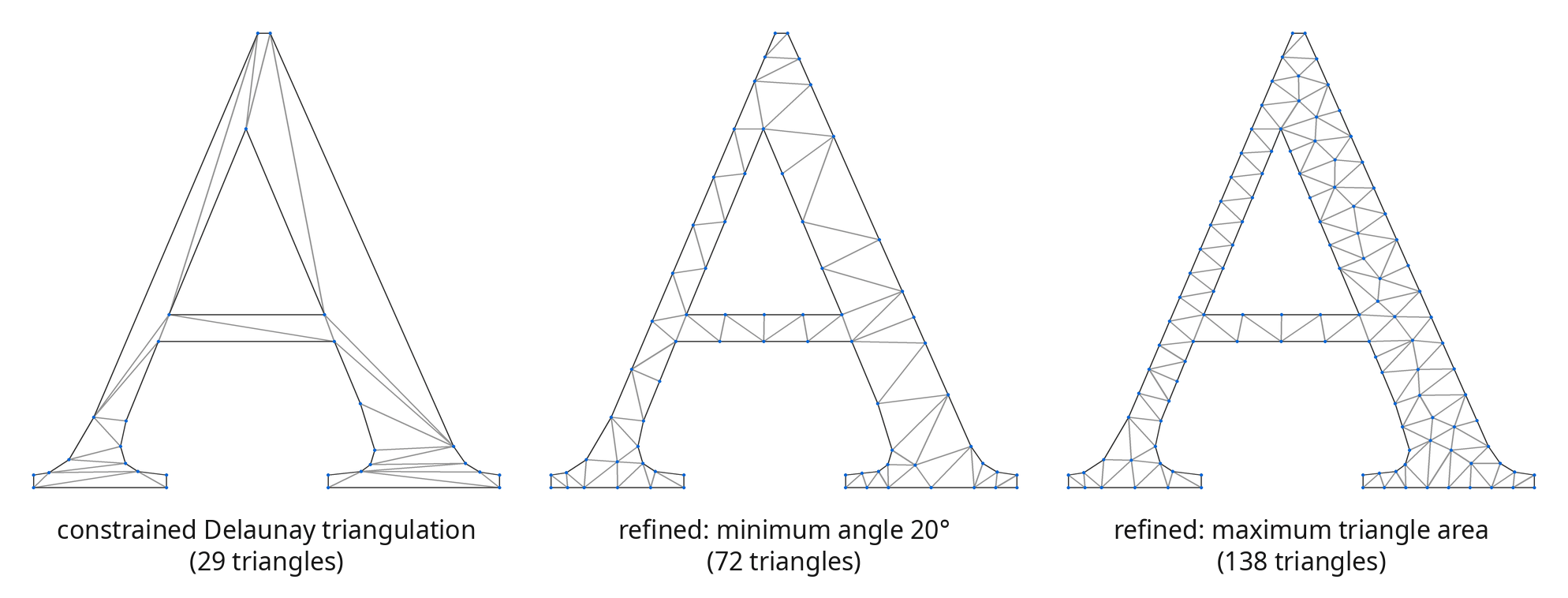
CDT::Triangulation::refineTriangles improves the shape of the triangles by inserting new points (Steiner points).
- Two criteria are supported with
CDT::RefinementCriterion:SmallestAngle: smallest angle of a triangle must be at least the threshold (in radians, useCDT::degToRad)LargestArea: area of a triangle must be at most the threshold
- Constraint edges are conformed to: an edge that is encroached by a nearby point is split. New points are never inserted across an input boundary.
- Refinement stops when the budget of inserted vertices
maxVerticesToInsertis used up. Edges and triangles that are already shorter thanminEdgeLengthare not split any further. - Refinement must be done before the triangulation is finalized with one of the
erasemethods. To refine only the triangles that are kept, collect the triangles to remove first (CDT::Triangulation::collectSuperTriangle,CDT::Triangulation::collectOuterTriangles,CDT::Triangulation::collectOuterTrianglesAndHoles), pass them toCDT::Triangulation::refineTriangles, and remove them afterwards withCDT::Triangulation::finalizeTriangulation.
Limits of refinement
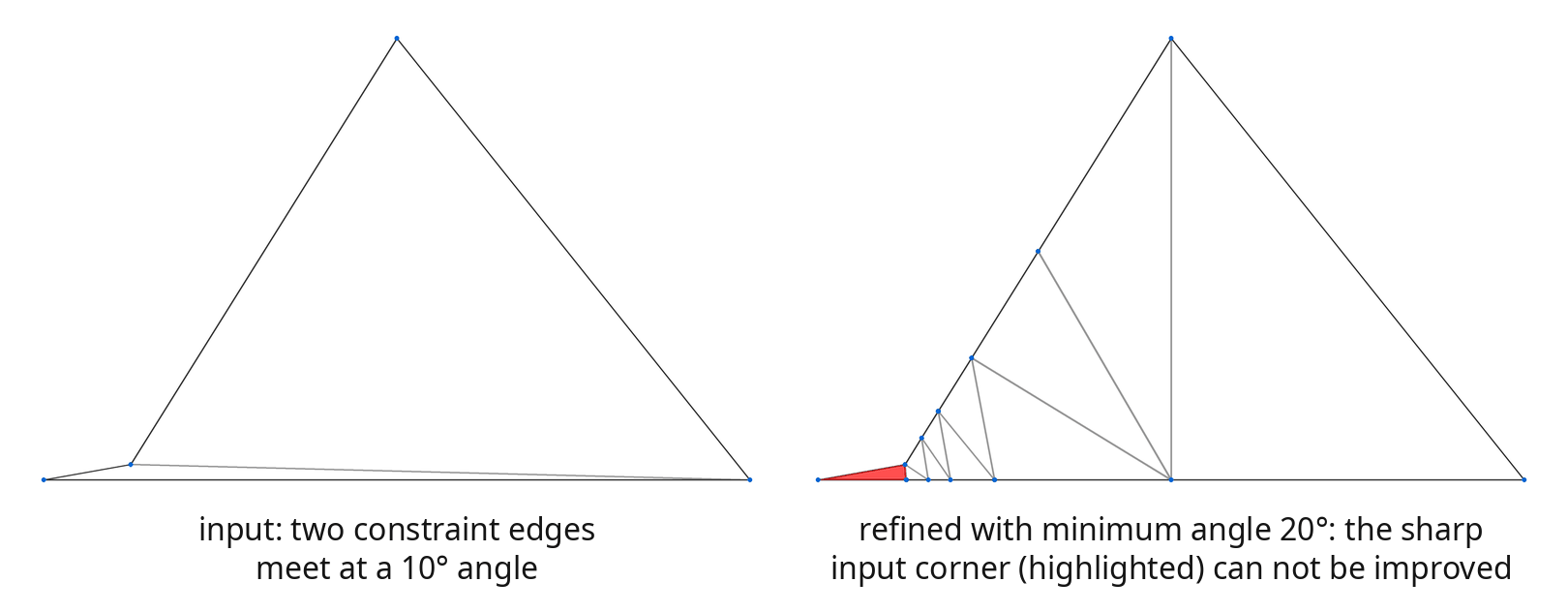
Some places can not be refined: e.g., a sharp angle between two constraint edges comes from the input and can not be made any larger.
CDT::Triangulation::refineTrianglesreturnsCDT::Unrefinedwith the counts of the refinements that could not be performedCDT::Triangulation::findUnrefinedTrianglesandCDT::Triangulation::findEncroachedFixedEdgeslocate such places in the resulting triangulation
Online Documentation
Latest online documentation (automatically generated with Doxygen).
Algorithm
- Implementation closely follows incremental construction algorithm by Anglada [1].
- During the legalization, the cases when at least one vertex belongs to super-triangle are resolved using an approach as described in Žalik et al. [2].
- For finding a triangle that contains inserted point remembering randomized triangle walk is used [3]. To find the starting triangle for the walk the nearest point is found using a kd-tree with mid-split nodes.
- Order in which vertices are inserted is controlled by
CDT::VertexInsertionOrder:CDT::VertexInsertionOrder::Autouses breadth-first traversal of a Kd-tree for initial bulk-load [4] and randomized insertion order for the subsequent calls ofCDT::Triangulation::insertVertices. Randomization improves performance and avoid worst-case scenarios. Generally vertex insertion withCDT::VertexInsertionOrder::Autois faster.- The original vertices order can be optied-in using
CDT::VertexInsertionOrder::AsProvidedwhen constructing a triangulation.
- Refinement closely follows Ruppert's Delaunay refinement algorithm [5]. Encroached constraint edges are split before a circumcenter is inserted. At input corners with a small angle the edges are split on concentric shells (powers of two) so that refinement terminates.
Pre-conditions:
- No duplicated points (use provided functions for removing duplicate points and re-mapping edges)
- No two constraint edges intersect each other (overlapping boundaries are allowed)
Post-conditions:
- Triangles have counter-clockwise (CCW) winding in a 2D coordinate system where X-axis points right and Y-axis points up.
Implementation Details
- Supports three ways of removing outer triangles:
CDT::Triangulation::eraseSuperTriangle: produce a convex-hullCDT::Triangulation::eraseOuterTriangles: remove all outer triangles until a boundary defined by constraint edgesCDT::Triangulation::eraseOuterTrianglesAndHoles: remove outer triangles and automatically detected holes. Starts from super-triangle and traverses triangles until outer boundary. Triangles outside outer boundary will be removed. Then traversal continues until next boundary. Triangles between two boundaries will be kept. Traversal to next boundary continues (this time removing triangles). Stops when all triangles are traversed.
- Supports overlapping boundaries
- Removing duplicate points and re-mapping constraint edges can be done using functions:
CDT::RemoveDuplicatesAndRemapEdges,CDT::RemoveDuplicates,CDT::RemapEdges - Uses William C. Lenthe's implementation of robust orientation and in-circle geometric predicates: github.com/wlenthe/GeometricPredicates
- On old compilers without C++11 support Boost is used as a fall back for missing C++11 standard library features.
- A demonstrator tool is included: requires Qt for GUI. When running demo-tool make sure that working directory contains files from 'data' folder.
Adding CDT to your C++ project Using a Package Manager
vcpkg
CDT port is available in Microsoft's vcpkg.
Conan
CDT is not in the conan-center but there's a conanfile.py recipe provided (in this repo). Note that it might need small adjustments like changing boost version to fit your needs.
spack
A recipe for CDT is available in spack.
Installation/Building
CDT uses modern CMake and should just work out of the box without any surprises. The are many ways to consume CDT:
- copy headers and use as a header-only library
- add to CMake project directly with
add_subdirectory - pre-build and add to CMake project as a dependency with
find_package - consume as a Conan package
CMake options
| Option | Default value | Description |
|---|---|---|
CDT_USE_64_BIT_INDEX_TYPE | OFF | Use 64bits to store vertex/triangle index types. Otherwise 32bits are used (up to 4.2bn items) |
CDT_USE_AS_COMPILED_LIBRARY | OFF | Instantiate templates for float and double and compiled into a library |
CDT_DISABLE_EXCEPTIONS | OFF | Disables exceptions: instead of throwing the library will call std::terminate |
CDT_ENABLE_CALLBACK_HANDLER | OFF | If enabled it is possible to provide a callback handler to the triangulation |
CDT_ENSURE_PRECISE_MATH_IN_CONSTRUCTIONS | OFF | Disables fast-math and floating-point contraction in constructions too, not only in predicates. See Floating-point compiler options |
Floating-point compiler options
CDT uses exact adaptive predicates (orientation, in-circle tests) which require strict IEEE-754 math. Options like -ffast-math, /fp:fast or -ffp-contract=fast can break them. Fast-math and floating-point contraction are therefore always disabled in the predicates. -ffast-math also sets a process-wide hardware mode that flushes subnormal numbers to zero. The predicates cannot disable this mode, so subnormal coordinates reach them as zero. float reaches the subnormal range much sooner than double. Another way inexact math can affect topology is by changing positions of constructed newly inserted vertices (e.g., at edges intersection). Opt-into exact math with CDT_ENSURE_PRECISE_MATH_IN_CONSTRUCTIONS, this will also ensure that 'golden' file-based tests pass.
Adding to CMake project directly
Can be done with add_subdirectory command (e.g., see CDT visualizer's CMakeLists.txt).
Adding to non-CMake project directly
To use as header-only copy headers from CDT/include
To use as a compiled library define CDT_USE_AS_COMPILED_LIBRARY and compile CDT.cpp
Consume pre-build CDT in CMake project with find_package
CDT provides package config files that can be included by other projects to find and use it.
Where to find CDT API
Public API is provided in two places:
CDT::Triangulationclass is used for performing constrained Delaunay triangulations.- Free functions in
CDT.hprovide some additional functionality for removing duplicates, re-mapping edges and triangle depth-peeling
Code Examples
ℹ️ For more up-to-date code examples please see CDT tests in cdt.test.cpp.
Delaunay triangulation without constraints (triangulated convex-hull)
Constrained Delaunay triangulation (auto-detected boundaries and holes)
Conforming Delaunay triangulation
Use CDT::Triangulation::conformToEdges instead of CDT::Triangulation::insertEdges
Refinement
Resolve edge intersections by adding new points and splitting edges
Pass CDT::IntersectingConstraintEdges::TryResolve to CDT::Triangulation constructor.
Resolving is not always possible for nearly-degenerate intersections (e.g. an intersection right next to an edge's endpoint): in such cases CDT::InvalidEdgeSplitVertex is thrown.
Custom point/edge type
Callbacks
For advanced usage and deep integration with custom algorithms CDT allows to register user callbacks for important events. For example it is possible to do progress reporting or abort triangulation.
⚠️ Callbacks need to be enabled with CDT_ENABLE_CALLBACK_HANDLER.
User needs to implement callback handler by deriving from CDT::ICallbackHandler and register it with CDT::Triangulation::setCallbackHandler. See cdt.test.cpp for usage examples.
Error handling
CDT reports errors by throwing exceptions. All of them derive from CDT::Error (itself a std::runtime_error) and carry a message and the source location they were thrown from.
| Exception | Thrown by | When |
|---|---|---|
CDT::FinalizedError | insertVertices, insertEdges, conformToEdges, refineTriangles, findEncroachedFixedEdges, collect... and erase... methods | triangulation was already finalized with one of the erase methods |
CDT::DuplicateVertexError | insertVertices | inserted vertex coincides with an already inserted one |
CDT::IntersectingConstraintsError | insertEdges, conformToEdges | constraint edges intersect while CDT::IntersectingConstraintEdges::NotAllowed is used |
CDT::InvalidEdgeSplitVertex | insertEdges, conformToEdges | intersection of constraint edges can not be resolved while CDT::IntersectingConstraintEdges::TryResolve is used: split vertex position is breaking triangulation topology due to floating-point rounding errors |
CDT::Error | insertVertices, insertEdges, conformToEdges | triangulation ended up in an unexpected state |
⚠️ With CDT_DISABLE_EXCEPTIONS the library calls std::terminate instead of throwing.
Python bindings?
For Python bindings check-out PythonCDT
Contributors
- Artem Amirkhanov
- Karl Åkerblom
- baiwenlei: dragging and zooming in the viewer
- Bärbel Holm: removing duplicates and re-mapping edges
- Andre Fecteau: benchmarking, profiling, and providing a kd-tree implementation a derivative of which is included in CDT
- msokalski: algorithm discussions and suggestions, bug finding
- alkonior: finding, reproducing, and reporting a bug (#142)
- ldcMasa: finding compilation issue (#144)
- egladil86: finding, reproducing, and reporting a bug (#148)
- Som1Lse: fuzzing CDT: finding, reproducing, and reporting bugs (#154)
- Madrich: help with implementing user callbacks (#178)
- davidkellerman: finding and reproducing bug in KDTree's
nearestmethod (#200) - Boris Clémençon: finding and reproducing, and reporting a bug (#204)
- Islam Omar: first implementation of Ruppert refinement
Contributing
Any feedback and contributions are welcome.
License
Mozilla Public License, v. 2.0
CDT includes third-party code under other licenses:
predicates.h: BSD-3-Clause, see LICENSE-predicates.txtportable_nth_element.hpp: Apache-2.0 WITH LLVM-exception, see LICENSE-LLVM.txt
For attribution you can use the following template:
Example Gallery
Bibliography
[1] Marc Vigo Anglada, An improved incremental algorithm for constructing restricted Delaunay triangulations, Computers & Graphics, Volume 21, Issue 2, 1997, Pages 215-223, ISSN 0097-8493.
[2] Borut Žalik and Ivana Kolingerová, An incremental construction algorithm for Delaunay triangulation using the nearest-point paradigm, International Journal of Geographical Information Science, Volume 17, Issue 2, Pages 119-138, 2003, DOI 10.1080/713811749.
[3] Olivier Devillers, Sylvvain Pion, Monique Tellaud, Walking in a triangulation, International Journal of Foundations of Computer Science, Volume 13, Issue 2, Pages 181-199, 2002
[4] Liu, Jianfei & Yan, Jinhui & Lo, S.. A new insertion sequence for incremental Delaunay triangulation. Acta Mechanica Sinica, Volume 29, 2013
[5] Jim Ruppert, A Delaunay refinement algorithm for quality 2-dimensional mesh generation, Journal of Algorithms, Volume 18, Issue 3, Pages 548-585, 1995, DOI 10.1006/jagm.1995.1021.